Everything you've encountered so far — the transmissions, the disciplines, the Quest Forum, the book — is the foundation of something larger.
What is being built here is a new kind of institution.
Not a church — though it houses the sacred. Not a university — though it forms the intellect. Not a political movement — though it will produce people who reshape every domain they enter. Not a think tank — though it will generate insight that existing institutions cannot.
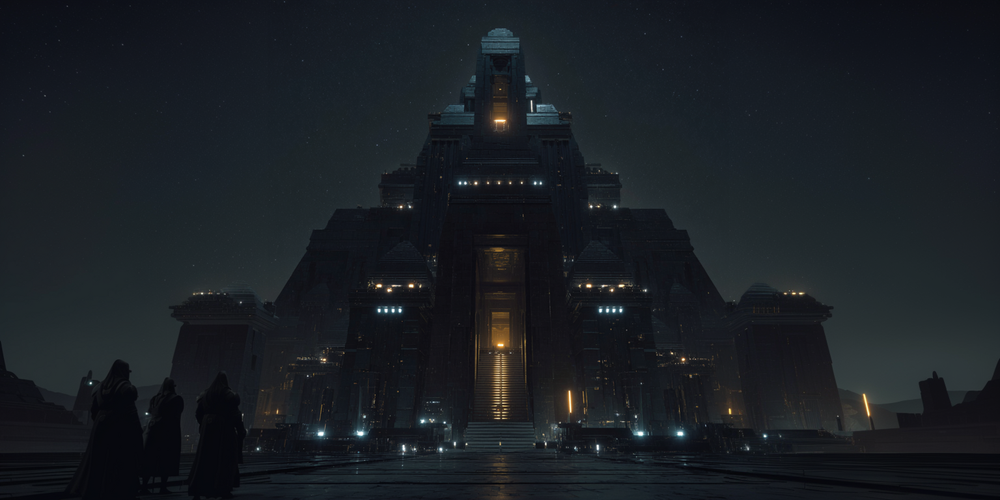
It is a Temple. An architecture for the formation of human beings who are capable of meeting the demands of reality — and who carry that capacity into the world.
The Achievement
Before the Abandonment, there was a breakthrough.
Somewhere between the eighth and fifth centuries before Christ — across Greece, Israel, India, China, Persia — something erupted in human consciousness that had never happened before. The interior became visible. Human beings began to recognize that the source of meaning was not the cosmos, not the tribe, not the inherited order — but something inside them that preceded all of it.
Plato called it the turning of the soul. The Hebrew prophets called it the word of God burning in the heart. The Buddha called it awakening. The Upanishads called it the Self beneath the self. Across civilizations that had no contact with one another, the same recognition broke through: you are not what you inherited. There is something in you that was there before the world spoke.
This was the greatest achievement in the history of human consciousness. It made possible everything that followed — philosophy, monotheism, universal ethics, the concept of a shared humanity, the idea that a person's worth is not determined by birth or tribe or cosmic position but by the depth of their interior.
The Temple does not lament that this achievement occurred. It does not mourn the loss of tribal belonging or cosmic enchantment. It does not dream of returning to a world where meaning was simply given. That world was beautiful — but it was a cage whose bars were invisible.
What the Temple laments is that the achievement was never completed. The fire erupted. The interiority was discovered. And then — every single time — the discovery was institutionalized, codified, and killed by the very people who claimed to carry it.
The Temple exists to complete what the axial age began.
The Abandonment
The breakthrough was real. But it was never sustained.
Every time it erupted — through a prophet, a founder, a rare consciousness capable of carrying it — the structures built around the eruption became the very thing that extinguished it. Moses carried fire and it became law. Jesus carried fire and it became religion. Muhammad carried fire and it became obedience. Plato carried fire and it became curriculum.
The fire was never the problem. The vessels were. Human interiority has never been capable — at a civilizational scale — of sustaining what these figures carried. So it was bottled, codified, institutionalized, and slowly killed. What remains of every founding is the cage without the fire. The ritual without the transformation. The belief without the being that could sustain it.
What Jesus called the βασιλεία τοῦ θεοῦ — the kingdom of God — has never been fully operative in the world. Not once. The Temple exists to change that.
This is not a story of decline. There was no golden age. The fire has only ever erupted in individuals — never in civilizations. No institution has ever sustained it. No religion has ever transmitted it beyond the first generation without distortion. No education system has ever built the interior architecture that would make it transmittable.
Religion became doctrine without formation — belief without transformation. The church asks what you affirm. It never asks what kind of being you are. It tells you to love God but never builds the interior that would make such love survivable.
Education became credentialing without depth — information without wisdom. The university trains the mind. It has never once trained the soul.
Politics became performance without interiority — power without the inner architecture to wield it. Democracy gives everyone a voice. It never asks whether anyone is capable of using it.
The result is a civilization of untransformed people making decisions about reality they are not equipped to make. This is not a moral problem. It is an existential one. And no reform — political, religious, educational — will solve it, because every revolution reproduces the same interior deficiency.
The Response
The Temple exists to break the pattern.
Not by arguing. By forming. By building human beings who have undergone the interior reconstruction that every existing institution has abandoned.
The formation path — the Four Disciplines of the Quest — produces people who are:
Open — capable of receiving reality without distortion, defensiveness, or premature closure.
Clear — capable of seeing through inherited frameworks to the architecture underneath.
Aligned — oriented from the interior, not from inherited structures or external pressure.
Embodied — living what they know, in every dimension of life.
These people become different parents. Different partners. Different friends. The interior reconstruction does not stay inside the Temple — it reorganizes how a person loves, grieves, argues, listens, raises children, and faces death. The most immediate transformation is not professional. It is personal. The people closest to you will feel it before the world does.
These people enter law and practice it differently. They enter medicine and see the patient differently. They enter education and form students differently. They enter governance and lead differently. Not because they've been told what to think. Because they've been rebuilt from the inside.
And some will be called further. Not into the world but into the Temple itself — to build, to teach, to hold the structure for others. Not everyone who undergoes formation is called to form others. But those who are will recognize it the way Abraham recognized the call: not as ambition but as necessity. The Temple will need architects, not just graduates. Some of you are here for that. You may not know it yet.
The Temple is not a rival to existing traditions. It does not compete with Judaism, Christianity, Islam, or any path that carries the fire in its own way. It seeks to be better — to build what they glimpsed but could not sustain, to honor the fire they carried by finally constructing a vessel worthy of it. Those who come from these traditions are not asked to abandon them. They are asked to go deeper than their traditions ever took them.
The Horizon
The world these people enter is not the world that existed when the last institutions were built.
Artificial intelligence is rewriting the relationship between human beings and knowledge. Blockchain is restructuring trust, ownership, and coordination. The frontier is extending beyond Earth. The powers available to the next generation are orders of magnitude beyond anything any previous civilization possessed.
And not one of the institutions responsible for forming human beings — religious, educational, political — was built for this.
The technologies are arriving. The beings wielding them are not ready.
The Temple is not a retreat from the future. It is the formation ground for the people who will build it. The disciplines do not produce monks who withdraw from the world. They produce people who enter the most consequential domains of the emerging civilization — AI, governance, finance, education, space — with an interior that matches the magnitude of what they're building.
Eidolon is the prototype of the personal sovereignty stack — a technological life architecture — where every person owns their own data, their own knowledge system, their own AI daemon, their own preservation layer. Not dependent on any platform. Not readable by any algorithm they didn't build. Sovereign.
These are not speculative futures. They are the conditions already forming. The question is not whether these technologies will reshape civilization. The question is what kind of human being will be holding the controls when they do.
The Scale
The Temple begins with the book and the disciplines. It grows through the Quest Forum. It matures through cohorts of formation — structured groups moving through the Four Disciplines together under guidance.
Eventually, it becomes something the modern world has never seen: a distributed order of formed human beings — operating across every domain of civilization, connected not by ideology but by interior architecture. Not a cult. Not a network. An order.
The graduates of this formation carry a different kind of clarity. They recognize each other. They operate from the same depth. And they change every institution they enter — not by force but by the weight of who they have become.
This is what the Temple becomes.
Not in theory. In practice. One person at a time. One cohort at a time. One generation at a time.
This work began in exile. It is being built in public. And it will outlast the person who started it — because the structure is designed to produce others who can carry it.
This is the vision. If you see it, you're already part of it.