

The world as symbol
Before the de-divinization of the cosmos and the etherealization of the numinous into some transcendent plane, it was widely regarded that creation itself—the manifest realm of experience—encoded “higher” metaphysical truths… that the features and facets of the world were transparent for a symbolic order beyond the immediacy of material reality. In the modern age we are accustomed to thinking that a stone is just a geological entity—an aggregate of minerals. But to the ancients, stone was a representation of absolute reality: something unchanging and indestructible… as something immune from growth and decay, it was a reminder of the eternal, and thus, divine order. A mountain becomes a meeting ground between heaven and earth; a tree—with its roots planted in the ground and branches reaching into the sky—serves as an axis interlinking the various realms of being. Sure, a stone “is” a stone—a geological entity made up of minerals. But that is only what it is made of…
More than cloth
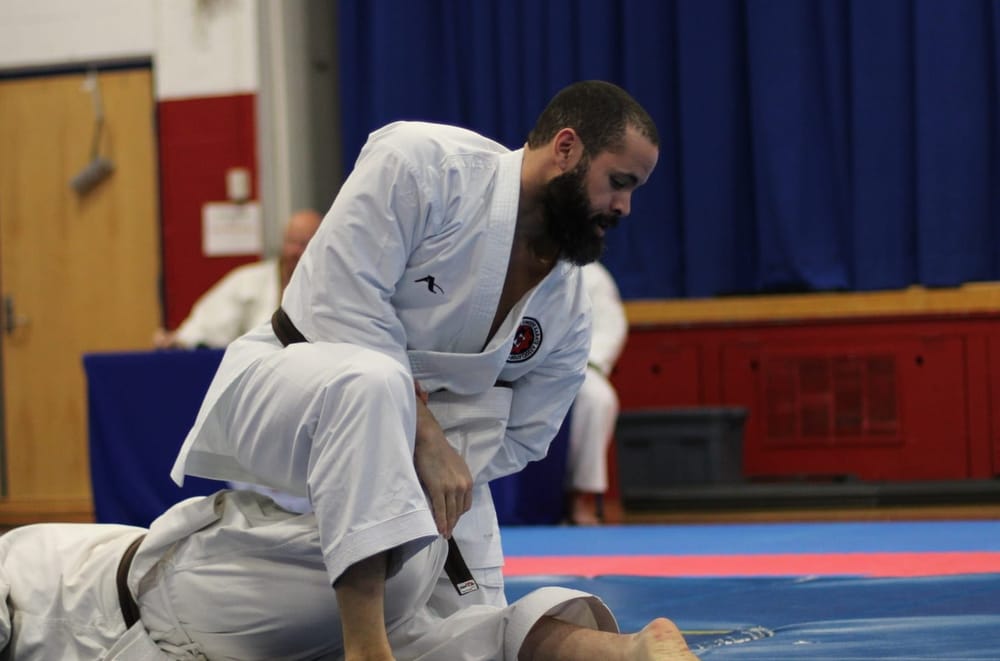
And a black belt is just a piece of cloth. We all know this. And sometimes our instructors like to remind us of this fact for pedagogical purposes, yet we all know that it stands for something more… but what exactly? Surely, a black belt is—or ideally should be—the ultimate aspiration of every nascent martial artist filled with exuberance and ready to take on this journey toward combat mastery. But anyone watching me take (and hopefully pass) my black belt exam will clearly see that obtaining a black belt can’t be solely about combat mastery because that is something I do not possess.
Perhaps working toward a black belt becomes a kind of return on investment—quiet obligation behind the grind that makes all of those bumps, bruises, blood, and mat burns worth it. A mark of survival. A test of will… a symbol of transformation? Now, I’m in no position to try and define what a black belt is for everyone, for just as a stone or a tree or a mountain can be multiple things simultaneously, a black belt can mean different things to different people… perhaps even different things to the same person across different phases of their life or in various contexts. But I can speak to what it means to me—at least from my current point of view…
Kindling the fire
Now, if it wasn’t obvious from the diction and demeanor of my writing, I’m a bit of a nerd: specifically, I’m one of those helpless idealists… the kind that gets a liberal arts degree because I genuinely love learning and I’m not so concerned with pragmatism. I never skipped a class in college. I would look at my watch not out of anticipation for when the bell would ring, but because I didn’t want the lecture to stop. And the scary thing is, I’m even more dedicated to my learning post-graduation than I ever was when I was enrolled in school. I’m a true autodidact and lifelong learner… but I wasn’t always this passionate. There were times in my schooling when I didn’t know how to navigate the balance between external demands and my intrinsic interests… in fact, I graduated in the bottom half of my high school class. But something hit me during the summer between my freshman and sophomore years in college, and despite never earning straight A’s once in my life, I walked to the honors college at my university, and made a deal: let me in, and I promise I will get straight A’s the rest of the time I’m in school. And I kept my promise.
“The mind is not a vessel to be filled but a fire to be kindled.”
—Plutarch (likely echoing Plato’s Seventh Letter)
When I reflect on that time, I can’t help but recognize that I know what it is to have a spark lit on the inside that drives and motivates you, and I undeniably feel the same love for the martial arts. And… I can’t help but see the common denominator.
Liberal arts, martial arts
Globally, the liberal arts at universities have been going through an identity crisis that I believe somewhat mirrors the current state of the martial arts (although I won’t belabor the parallel too impudently). Faculty find themselves marketing the worth and value of a liberal arts degree by emphasizing job readiness, critical thinking and problem solving, effective communication and adaptability… perhaps ethical reasoning, civic and cultural engagement, and even leadership skills. Now, a thing can be multiple things simultaneously, and everything I just mentioned are perfectly noble outcomes of a liberal arts education… but from a classical point of view, the liberal arts were not reducible and relativized to an external end.
See, where the utilitarian worker might fulfill the demands of commerce, and where the fine artist creates works of beauty that elevate the human spirit… both teach us how to serve another. In contrast, it was an incredible privilege to be free from solely the concerns of necessity, production, and raw pragmatism. To pursue the liberal arts was to pursue an intransitive path that would increase the intrinsic worth of the individual… to arm the mind with the tools necessary for the contemplation of ultimate ends and seeing the big picture… to know not just how to fight but to have the wisdom to know what fights are worth fighting.
There’s an idea from Nietzsche that the moment something requires justification for its value, it has already begun to decay. All of the aforementioned noble outcomes of a liberal arts education—job readiness, critical thinking, etc.—are, to me, secondary and tertiary effects that we lean into either out of the necessity of appealing to consumers or because we’ve lost sight of some inner vitality. So that’s the parallel… fitness, self-defense, community—all noble things that to me are the secondary and tertiary effects of practicing the martial arts. But here’s the difference: enchantment with the martial arts does not need to be nearly as cultivated as the life of the mind. The appeal of the martial arts is arguably immediate and self-evident. But why? Is the idea of walking a path of inner transformation toward self-mastery really what motivated me? At least for me, it wasn’t… and I’m someone who is self-conscious of identifying with the pursuit of virtue and excellence. For me, self-mastery is too abstract and mature to be a motivating force; for me, self-mastery feels more like the fruit that we become aware of as the real ultimate benefit of our training in retrospect and hindsight. My real motivation seems to be something far more visceral and far more childlike… the martial arts are just really freakin’ cool.
Why we start
My first exposure to the martial arts was in sixth grade as an after-school Tae Kwon Do program. But that Tae Kwon Do program was part of a larger set of options, which means that me—and my twin sister—chose to do Tae Kwon Do… why did I choose Tae Kwon Do? I couldn’t tell you. Maybe it was to learn how to beat up my annoying twin sister… but the fact remains that I felt some inner draw toward the martial arts that surely I couldn’t articulate at the time. And I’m not even sure that my attraction to the martial arts made sense because I don’t think I made sense… I was a walking contradiction: my mom is a Christian white woman from West Virginia, and my father was some famous Muslim African politician… on one hand, I was a very sweet and gentle kid; but on the other hand, I was a huge troublemaker—and when I’m dealing with the rowdy and ornery kids at the dojo, I can’t help but feel like maybe this is a dose of some well-deserved karma. I loved to win, but I also felt bad for defeating my opponent… I hated violence, but I undeniably had